AUTOXING Park Logistics Closed-Loop Solution: Outdoor Autonomous Vehicles + AMRs + Autonomous Forklifts to Connect Indoor & Outdoor Last-Mile Logistics
In large manufacturing parks, logistics bases and industrial zones, a prominent logistics pain point lies in the disconnect between indoor and outdoor workflows. While AMRs and forklifts operate efficiently indoors, manual trucks or trailers are still required to transfer materials from factory gates and central warehouses to workshop entrances, creating workflow bottlenecks. AUTOXING builds a fully unmanned closed-loop solution covering factory gates all the way to production line workstations via three-tier collaboration of outdoor autonomous transporters, mobile AMRs and unmanned forklifts.
1. Role Division of Three Product Lines
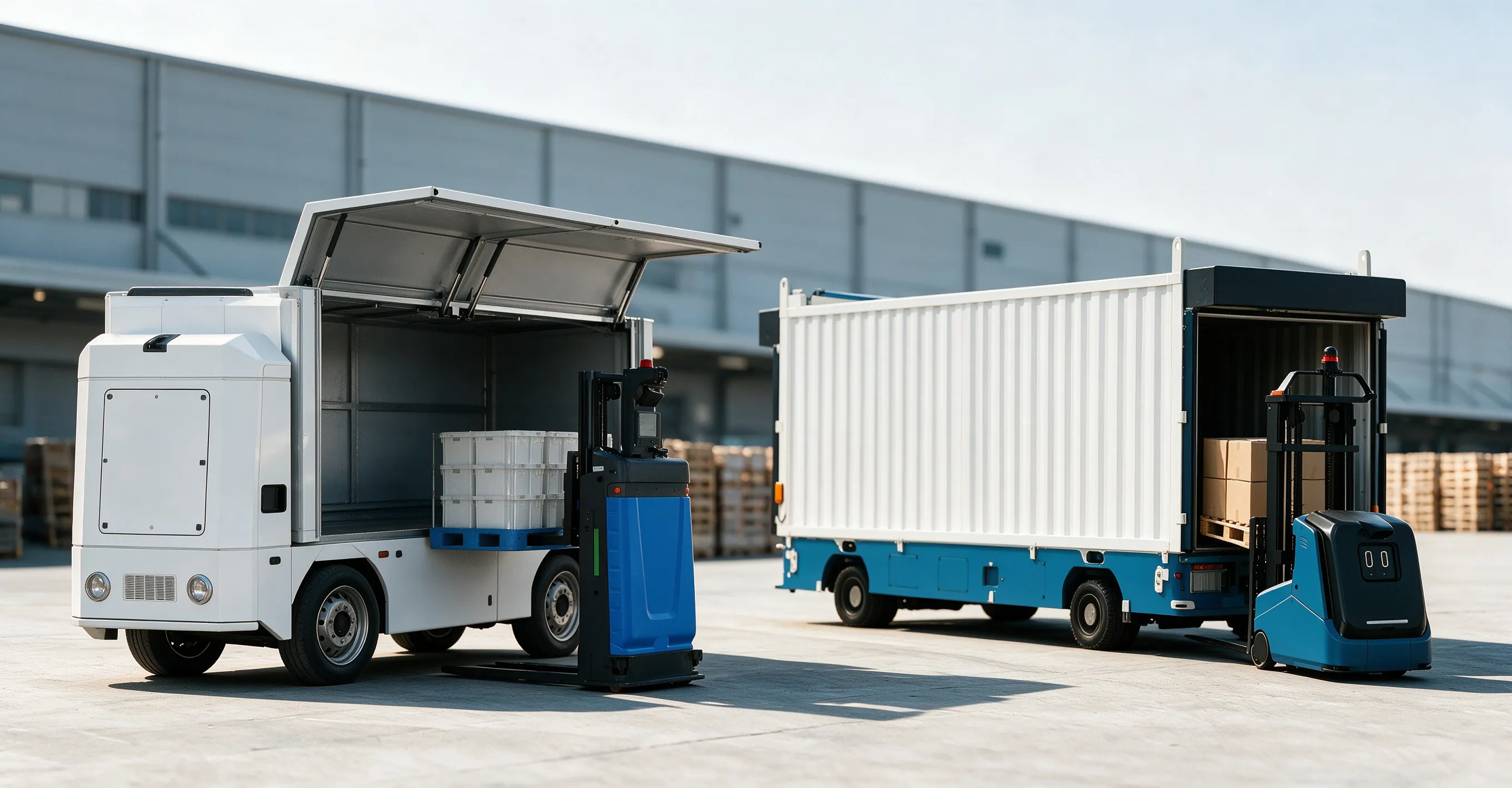
- Outdoor Autonomous Transporters (V-2100 / V-10T) Models: V-2100 (2.1-ton load), V-10T (10-ton load) Core responsibility: Long-distance heavy-load cross-park transportation, connecting factory gates, central warehouses and workshop entrances; applicable to park roads, outdoor plazas and spaces between buildings.
- Autonomous Forklifts (FT1500 / FT2000 / FS1500) Core responsibility: Loading/unloading at indoor-outdoor transfer points, high rack storage & retrieval, pallet transit; applicable to workshop entrances, warehouse interiors and loading docks.
- Mobile AMRs (D / L / S / Towing Series) Core responsibility: Line-side material feeding, production line docking, cross-floor transportation and precise alignment; applicable to workshop interiors, production line sides and warehouse aisles.
2. Typical Closed-Loop Scenario: Fully Unmanned Delivery from Central Warehouse to Production Lines
Scenario: An electronics manufacturing park transporting materials from central warehouse to assembly workshop
- Step 1: Cross-park transportation by outdoor autonomous vehicle
- Staff at the central warehouse load material pallets onto the V-2100 vehicle.
- The dispatching system releases delivery tasks. The V-2100 travels autonomously along pre-planned park roads at a max speed of 2m/s with a 200km range to support multiple daily trips.
- The vehicle docks precisely at the automatic loading dock of the assembly workshop.
- Step 2: Transfer & warehousing via autonomous forklift
- The FT2000 autonomous forklift at the workshop entrance receives the task and drives automatically to the rear of the V-2100.
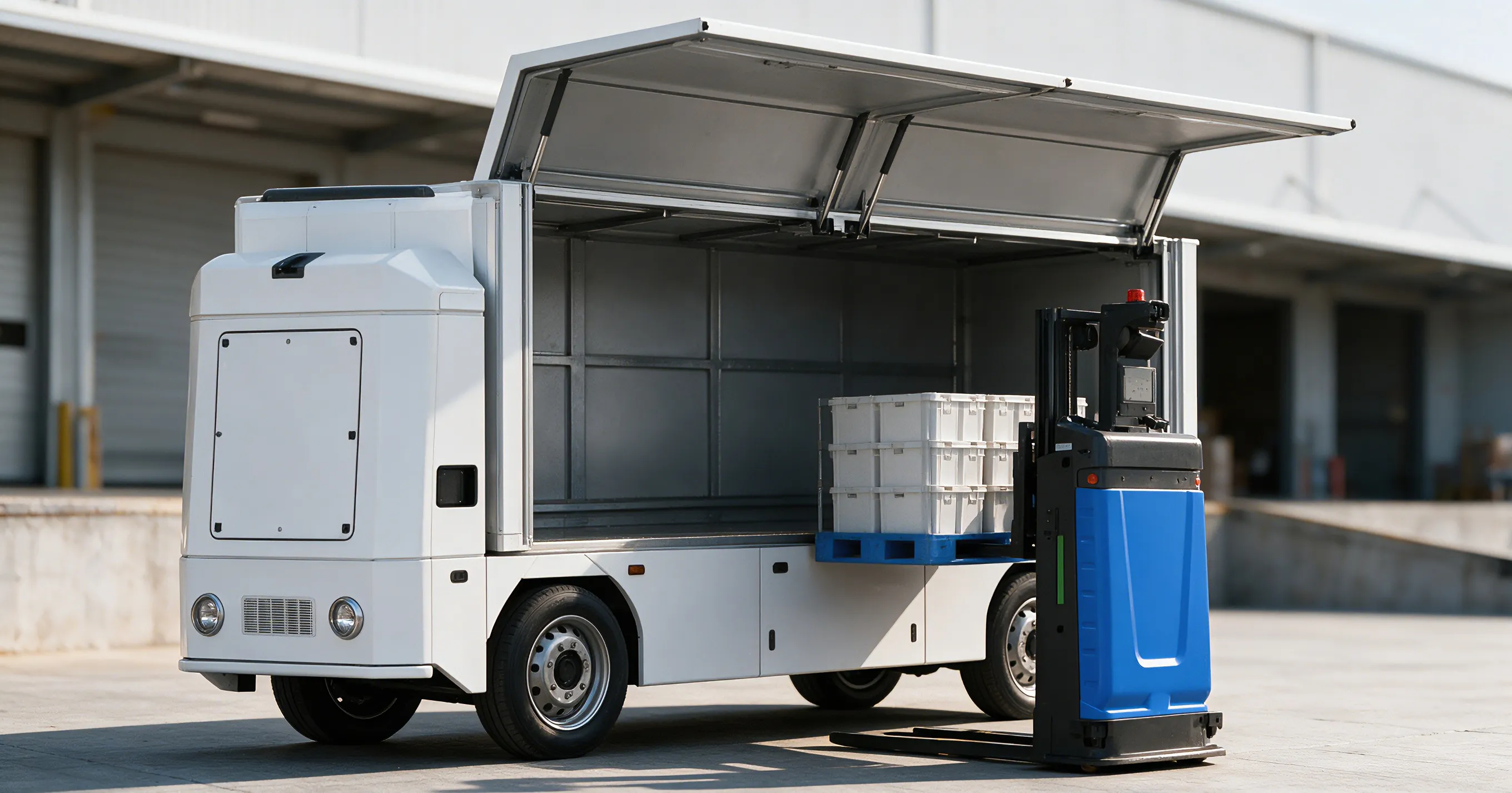
- The forklift unloads pallets from the vehicle compartment or completes cargo handover via an automatic lifting tailgate.
- The forklift transports pallets to buffer zones or high racks inside the workshop for temporary storage or warehousing.
- Step 3: Precise line-side delivery by AMR
- Production line workstations send material requests via call buttons or the MES system.
- S-series underlift AMRs or AX delivery robots pick up goods from buffer zones, navigate workshop aisles autonomously, and avoid pedestrians and other equipment.
- Robots drop off materials or lift racks at target workstations to finish the last-meter delivery.
- Empty AMRs automatically return to standby points or take on subsequent tasks.
Full closed-loop workflow: Central Warehouse → V-2100 (long-distance outdoor transit) → FT2000 (loading/unloading & storage) → D/L/S-series AMRs (short-distance indoor delivery) → Production Workstations. The whole process is unmanned with full traceability across all links.
3. Cross-Workshop Material Transit
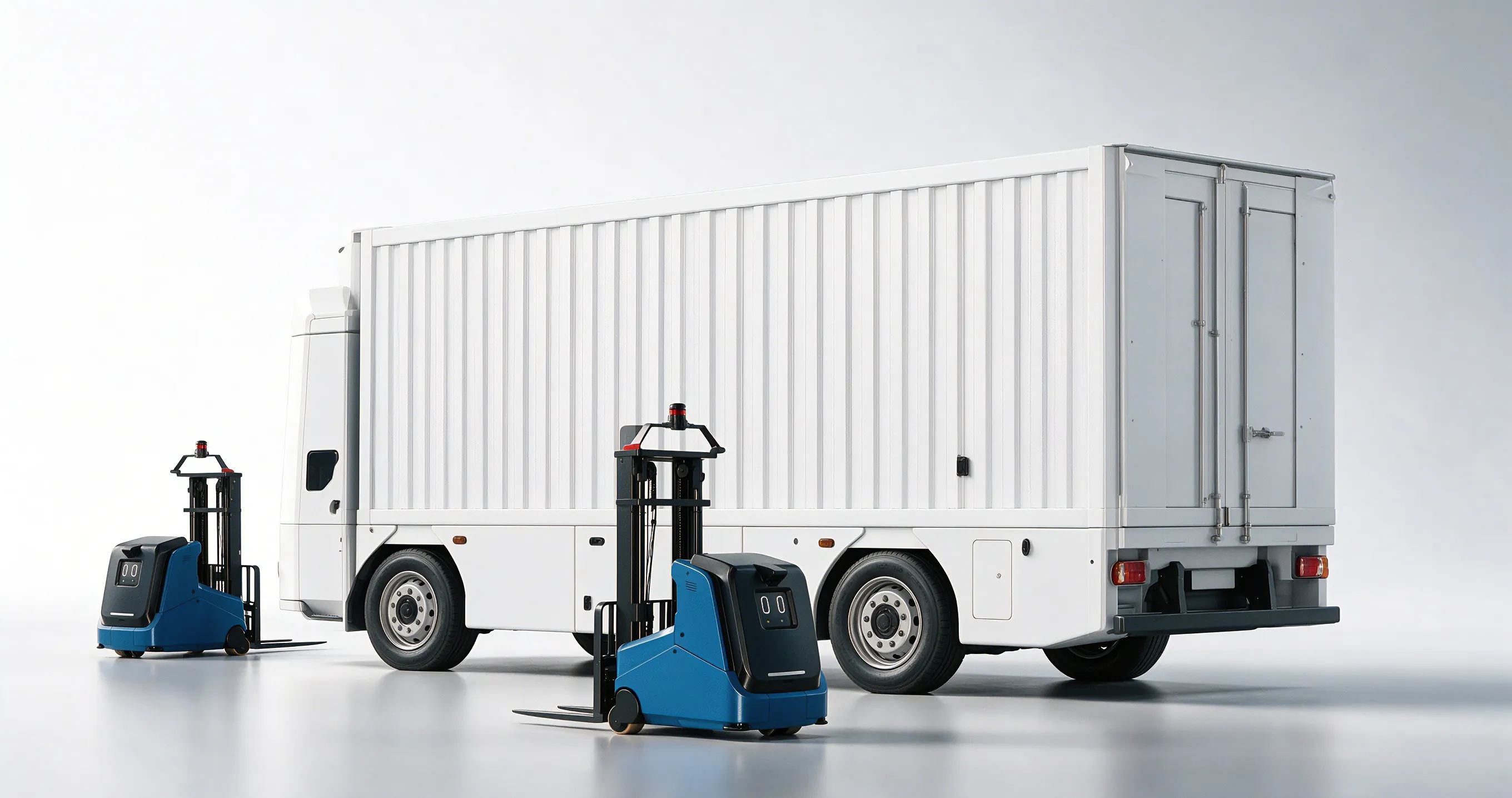
- The V-10T vehicle loads heavy components such as engines and molds from Workshop A and drives to the entrance of Workshop B.
- The FT1500 forklift unloads cargo from the V-10T, then D300-T towing AMRs hook up the goods and haul them to production line sides.
- Advantage: Eliminates manual trucks for heavy cross-workshop transport and cuts waiting & loading/unloading times.
4. Linkage Between Multi-Story Warehouses & Outdoor Yards
- Raw materials stored in outdoor yards are delivered to the ground-floor unloading zone by V-2100 vehicles.
- FT2000 forklifts carry pallets to freight elevators, or coordinate with L-series lift AMRs that take elevators autonomously to deliver materials to second and third-floor production lines.
- Advantage: Connects vertical and horizontal logistics covering outdoor yards, ground-floor warehouses and upper-floor production lines.
5. Emergency Material Replenishment & Exception Handling
- If production lines face sudden material shortages, the MES system automatically raises the priority of replenishment tasks.
- AX-series delivery robots respond first to fetch materials from line-side buffers; if line-side stock runs out, the system dispatches V-2100 vehicles to rush supplies from the central warehouse.
- FT2000 forklifts stay on standby at transfer points to achieve instant unloading and immediate delivery.
- Advantage: Dynamic task scheduling ensures non-stop production lines.
6. Collaboration Modes & Coordination Mechanisms
- Task Collaboration All three vehicle types are uniformly managed by the same RCS dispatching system, which intelligently allocates tasks based on task type and equipment location, compliant with the VDA5050 standard.
- Transfer Collaboration When outdoor vehicles arrive at transfer points, V2X near-field communication or cloud signals notify forklifts and AMRs to get ready; automatic lifting tailgates support seamless cargo handover.
- Traffic Collaboration Outdoor vehicles travel on fixed park routes; indoor AMRs and forklifts run on guided or free navigation paths without mutual interference. The RCS system manages intersections with traffic control and block mutex locks to prevent conflicts.
- Information Collaboration Real-time synchronization of all equipment status, positions and task progress on the cloud platform, supporting remote monitoring and dispatching via the big-data robot management dashboard.
7. Core Solution Advantages
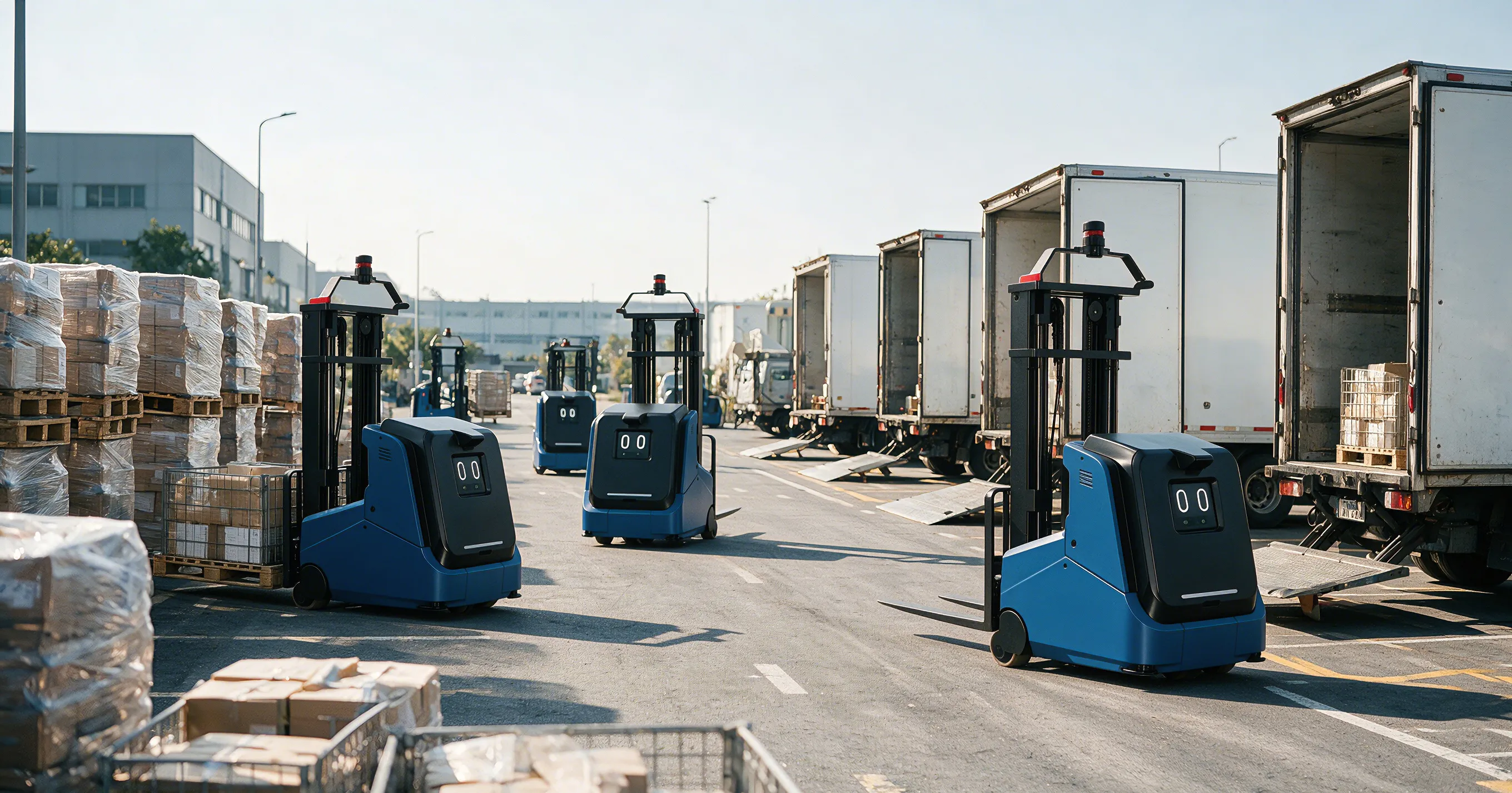
- Fully eliminate indoor-outdoor logistics bottlenecks Traditional solutions end outdoor truck workflows at factory gates, requiring manual forklifts to unload and hand over goods to indoor AGVs. Our solution realizes end-to-end unmanned delivery from vehicle compartments to workstations and removes all intermediate manual transfer steps.
- Tiered task division to maximize overall efficiency
- Outdoor vehicles: Handle long-distance heavy-load transport with superior speed and endurance.
- Forklifts: Specialize in loading, stacking and high-position storage with powerful lifting and precise alignment capabilities.
- AMRs: Deliver flexible, high-frequency multi-point indoor materials with low deployment costs. Each equipment type performs matching tasks, avoiding efficiency waste from mismatched load and distance.
- Flexible scaling for all park sizes
- Small parks can deploy a basic closed-loop system with 1 V-2100 plus 2 AMRs.
- Large parks can expand to dozens of outdoor vehicles and hundreds of AMRs & forklifts; the RCS system supports horizontal capacity expansion.
- Digitalized management with full-link tracking All tasks are fully recorded from initiation to completion. Visualized operational data helps optimize logistics cycles, identify workflow bottlenecks and quantify cost-saving outcomes.
- Lower comprehensive logistics costs
- Replaces manual truck drivers, forklift operators and porters, cutting indoor-outdoor logistics labor by 50%~70%.
- Reduces material loss, delivery delays and management overhead caused by manual handling.
8. Measurable Efficiency Improvements for Clients
- Cross-park transit time (Central Warehouse → Workshop): Cut from 30–60 mins (with waiting & loading) to 15–25 mins (seamless connection), a 50%+ reduction
- Daily delivery trips: Manual trucks complete 4–6 trips/day; autonomous outdoor vehicles run 8–12 trips/day with auto-charging, a 100% increase
- Indoor delivery response time (request to material arrival): Shortened from 20–40 mins to 5–10 mins, a 75% reduction
- Manual intervention nodes: 2–3 workers (driver + forklift operator + porter) per trip → 0 personnel for full unmanned operation, 100% labor reduction
- Task error rate: Prone to human record errors under manual operation; automatic system tracking keeps error rate ≤0.03%, drastically lowering mistakes
9. Summary
AUTOXING’s three-tier collaborative solution combining outdoor autonomous transporters, unmanned forklifts and AMRs creates a complete closed-loop park logistics system with integrated indoor-outdoor workflows, tiered load capacity and mixed light & heavy-duty equipment. This solution resolves traditional park logistics bottlenecks. Powered by intelligent dispatching and full-link digitalization, it helps customers cut costs, boost efficiency, improve product quality and reduce labor headcounts, serving as a core tool to strengthen park logistics competitiveness.
Contact the AUTOXING team for detailed vehicle configurations, deployment plans and ROI calculation reports.
AUTOXING Park Logistics Closed-Loop Solution: Outdoor Autonomous Vehicles + AMRs + Autonomous Forklifts to Connect Indoor & Outdoor Last-Mile Logistics
In large manufacturing parks, logistics bases and industrial zones, a prominent logistics pain point lies in the disconnect between indoor and outdoor workflows. While AMRs and forklifts operate efficiently indoors, manual trucks or trailers are still required to transfer materials from factory gates and central warehouses to workshop entrances, creating workflow bottlenecks. AUTOXING builds a fully unmanned closed-loop solution covering factory gates all the way to production line workstations via three-tier collaboration of outdoor autonomous transporters, mobile AMRs and unmanned forklifts.
1. Role Division of Three Product Lines
- Outdoor Autonomous Transporters (V-2100 / V-10T) Models: V-2100 (2.1-ton load), V-10T (10-ton load) Core responsibility: Long-distance heavy-load cross-park transportation, connecting factory gates, central warehouses and workshop entrances; applicable to park roads, outdoor plazas and spaces between buildings.
- Autonomous Forklifts (FT1500 / FT2000 / FS1500) Core responsibility: Loading/unloading at indoor-outdoor transfer points, high rack storage & retrieval, pallet transit; applicable to workshop entrances, warehouse interiors and loading docks.
- Mobile AMRs (D / L / S / Towing Series) Core responsibility: Line-side material feeding, production line docking, cross-floor transportation and precise alignment; applicable to workshop interiors, production line sides and warehouse aisles.
2. Typical Closed-Loop Scenario: Fully Unmanned Delivery from Central Warehouse to Production Lines
Scenario: An electronics manufacturing park transporting materials from central warehouse to assembly workshop
- Step 1: Cross-park transportation by outdoor autonomous vehicle
- Staff at the central warehouse load material pallets onto the V-2100 vehicle.
- The dispatching system releases delivery tasks. The V-2100 travels autonomously along pre-planned park roads at a max speed of 2m/s with a 200km range to support multiple daily trips.
- The vehicle docks precisely at the automatic loading dock of the assembly workshop.
- Step 2: Transfer & warehousing via autonomous forklift
- The FT2000 autonomous forklift at the workshop entrance receives the task and drives automatically to the rear of the V-2100.
- The forklift unloads pallets from the vehicle compartment or completes cargo handover via an automatic lifting tailgate.
- The forklift transports pallets to buffer zones or high racks inside the workshop for temporary storage or warehousing.
- Step 3: Precise line-side delivery by AMR
- Production line workstations send material requests via call buttons or the MES system.
- S-series underlift AMRs or AX delivery robots pick up goods from buffer zones, navigate workshop aisles autonomously, and avoid pedestrians and other equipment.
- Robots drop off materials or lift racks at target workstations to finish the last-meter delivery.
- Empty AMRs automatically return to standby points or take on subsequent tasks.
Full closed-loop workflow: Central Warehouse → V-2100 (long-distance outdoor transit) → FT2000 (loading/unloading & storage) → D/L/S-series AMRs (short-distance indoor delivery) → Production Workstations. The whole process is unmanned with full traceability across all links.
3. Cross-Workshop Material Transit
- The V-10T vehicle loads heavy components such as engines and molds from Workshop A and drives to the entrance of Workshop B.
- The FT1500 forklift unloads cargo from the V-10T, then D300-T towing AMRs hook up the goods and haul them to production line sides.
- Advantage: Eliminates manual trucks for heavy cross-workshop transport and cuts waiting & loading/unloading times.
4. Linkage Between Multi-Story Warehouses & Outdoor Yards
- Raw materials stored in outdoor yards are delivered to the ground-floor unloading zone by V-2100 vehicles.
- FT2000 forklifts carry pallets to freight elevators, or coordinate with L-series lift AMRs that take elevators autonomously to deliver materials to second and third-floor production lines.
- Advantage: Connects vertical and horizontal logistics covering outdoor yards, ground-floor warehouses and upper-floor production lines.
5. Emergency Material Replenishment & Exception Handling
- If production lines face sudden material shortages, the MES system automatically raises the priority of replenishment tasks.
- AX-series delivery robots respond first to fetch materials from line-side buffers; if line-side stock runs out, the system dispatches V-2100 vehicles to rush supplies from the central warehouse.
- FT2000 forklifts stay on standby at transfer points to achieve instant unloading and immediate delivery.
- Advantage: Dynamic task scheduling ensures non-stop production lines.
6. Collaboration Modes & Coordination Mechanisms
- Task Collaboration All three vehicle types are uniformly managed by the same RCS dispatching system, which intelligently allocates tasks based on task type and equipment location, compliant with the VDA5050 standard.
- Transfer Collaboration When outdoor vehicles arrive at transfer points, V2X near-field communication or cloud signals notify forklifts and AMRs to get ready; automatic lifting tailgates support seamless cargo handover.
- Traffic Collaboration Outdoor vehicles travel on fixed park routes; indoor AMRs and forklifts run on guided or free navigation paths without mutual interference. The RCS system manages intersections with traffic control and block mutex locks to prevent conflicts.
- Information Collaboration Real-time synchronization of all equipment status, positions and task progress on the cloud platform, supporting remote monitoring and dispatching via the big-data robot management dashboard.
7. Core Solution Advantages
- Fully eliminate indoor-outdoor logistics bottlenecks Traditional solutions end outdoor truck workflows at factory gates, requiring manual forklifts to unload and hand over goods to indoor AGVs. Our solution realizes end-to-end unmanned delivery from vehicle compartments to workstations and removes all intermediate manual transfer steps.
- Tiered task division to maximize overall efficiency
- Outdoor vehicles: Handle long-distance heavy-load transport with superior speed and endurance.
- Forklifts: Specialize in loading, stacking and high-position storage with powerful lifting and precise alignment capabilities.
- AMRs: Deliver flexible, high-frequency multi-point indoor materials with low deployment costs. Each equipment type performs matching tasks, avoiding efficiency waste from mismatched load and distance.
- Flexible scaling for all park sizes
- Small parks can deploy a basic closed-loop system with 1 V-2100 plus 2 AMRs.
- Large parks can expand to dozens of outdoor vehicles and hundreds of AMRs & forklifts; the RCS system supports horizontal capacity expansion.
- Digitalized management with full-link tracking All tasks are fully recorded from initiation to completion. Visualized operational data helps optimize logistics cycles, identify workflow bottlenecks and quantify cost-saving outcomes.
- Lower comprehensive logistics costs
- Replaces manual truck drivers, forklift operators and porters, cutting indoor-outdoor logistics labor by 50%~70%.
- Reduces material loss, delivery delays and management overhead caused by manual handling.
8. Measurable Efficiency Improvements for Clients
- Cross-park transit time (Central Warehouse → Workshop): Cut from 30–60 mins (with waiting & loading) to 15–25 mins (seamless connection), a 50%+ reduction
- Daily delivery trips: Manual trucks complete 4–6 trips/day; autonomous outdoor vehicles run 8–12 trips/day with auto-charging, a 100% increase
- Indoor delivery response time (request to material arrival): Shortened from 20–40 mins to 5–10 mins, a 75% reduction
- Manual intervention nodes: 2–3 workers (driver + forklift operator + porter) per trip → 0 personnel for full unmanned operation, 100% labor reduction
- Task error rate: Prone to human record errors under manual operation; automatic system tracking keeps error rate ≤0.03%, drastically lowering mistakes
9. Summary
AUTOXING’s three-tier collaborative solution combining outdoor autonomous transporters, unmanned forklifts and AMRs creates a complete closed-loop park logistics system with integrated indoor-outdoor workflows, tiered load capacity and mixed light & heavy-duty equipment. This solution resolves traditional park logistics bottlenecks. Powered by intelligent dispatching and full-link digitalization, it helps customers cut costs, boost efficiency, improve product quality and reduce labor headcounts, serving as a core tool to strengthen park logistics competitiveness.
Contact the AUTOXING team for detailed vehicle configurations, deployment plans and ROI calculation reports.


